


Hundreds of years ago, the Landes was not as it is today.
There were very
large and flat expanses with high brushwoods and marshes.
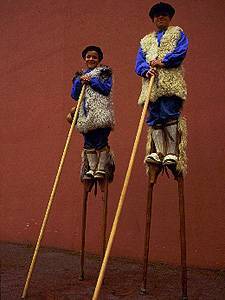
For the shepherds to watch over their flocks, they had to go on stilts
(around 1.40m to 1.50m high) called "Echasses". (The name for the men using
these stilts are "Echassiers".)
To attach the stilts to their legs, they have leather belts and to prevent
the belts rubbing, they had gaiters "garnaches", these they knitted
themselves when they were watching over their sheep.
They wore a sheep skin vest ("prisse") and as they had to make them
themselves, they had very nice ones.
To complete the uniform, they wore a black beret winter & summer.
They also carried a "cuyoun" which is the ancestor of the Thermos flask. A
dryed marrow in which they kept their beverages either cold or warm.
Finally they had a long stave (pine poll), which was essential for the "échassier", because he had to lean on something to keep his stability during long periods on his feet/stilts. It was also very useful to help him mount and dismount the stilts with only the strength of his arms, as generally he was by himself.
Stilts were also used by the postmen to travel through the area a lot
quicker than by feet. The stilts were abandoned for a few years and then
found utility again during the "Jacquerie" when the Landes was inundated
with wolves, because the farmers were unarmed. With the stilts they could
see the wolf packs arriving and stop them killing their flocks.
The Landaise young girls wore light coloured clothes until she was married
and then she had to wear black.
As originally stated the Landes was a marshy shrubland for hundreds of years, flooding from time to time when a high Atlantic tide would sweep accross the flat plains or the Adour river would burst its banks with heavy rain or a fast snow melt down in the Pyrenees mountains, where the river starts its flow.
The Landaise folk and successive Regional & Country Governments had to find an answer to stop the floods and marshy existance of the Landes Departement, as it covered a vast area
Firstly, conditions improved when the River Adour was re-routed (originally it flowed to towards Vieux Boucau and then onto Capbreton) from Dax to turn towards Peyrehorade and on to Bayonne after joining the Gaves de Pau and Oloron through higher ground in the late 16th & early 17th Centuries.
Secondly, much later on in the early to mid 19th Century, the order was given to construct the sand dunes along the coastal beaches to protect the land from the sea and these were planted with a creeping grass which was to hold the dunes together and to stop them from blowing away with a strong Atlantic (Bay of Biscay) wind.
Finally the Landes was planted with Pine-Trees (because an adult pine-tree drinks 200 liters of water each day). That's how the Landes was finally drained.
